
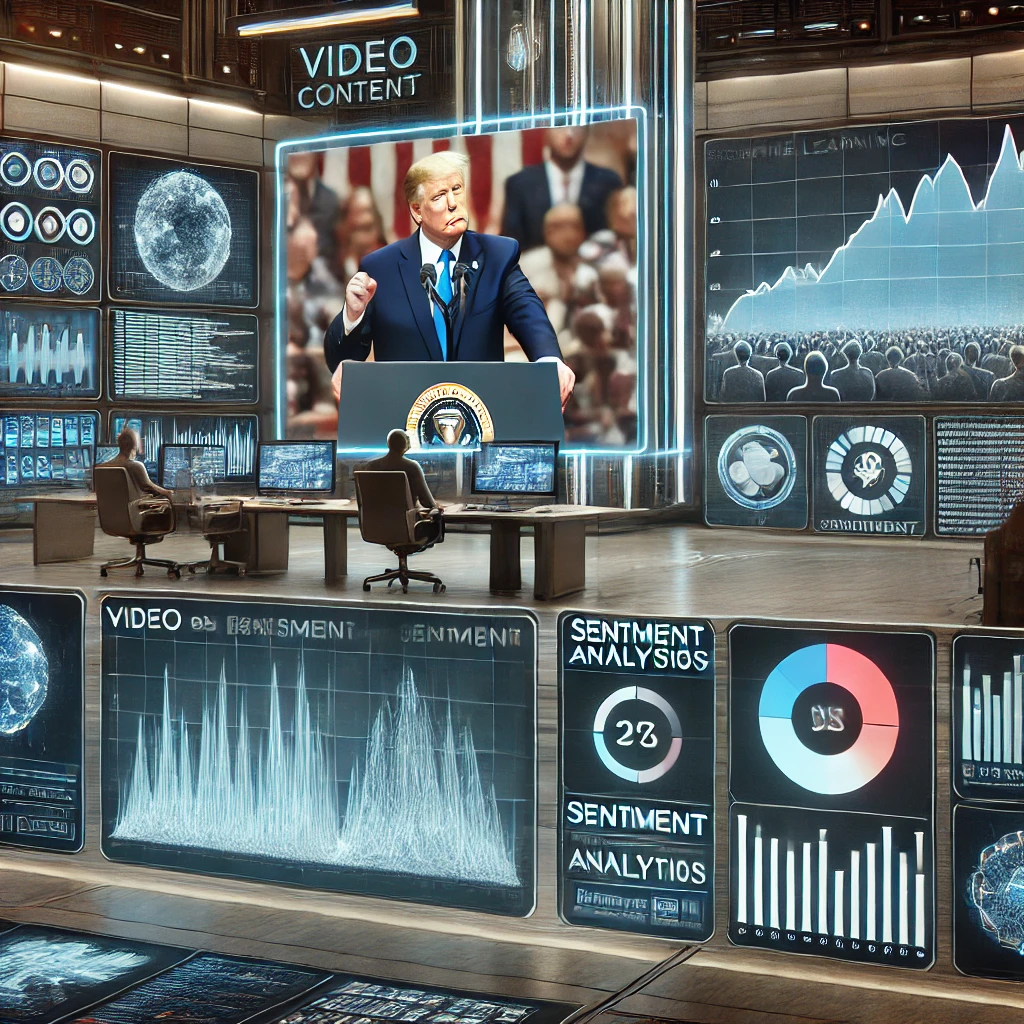
Possible title: Decoding the Trump Phenomenon: A Political Communication Study Using Machine Learning on YouTube Footage
Introduction
In recent years, machine learning (ML) has revolutionized the way we analyze data, especially in fields like media and political communication. This proposed study aims to explore Donald Trump’s YouTube presence, focusing on his public speeches and appearances from 2015 to 2024. By applying machine learning techniques, I will investigate patterns in rhetoric, sentiment, and audience engagement to better understand Trump’s communication style during this critical period in U.S. politics.
Research Objectives
This study will address the following objectives:
- Sentiment Analysis: How did the sentiment of Trump’s speeches evolve between 2015 and 2024?
- Rhetorical Patterns: What rhetorical techniques did Trump employ in his public addresses, and how consistent were these across different contexts?
- Visual and Audio Cues: Can machine learning detect any correlations between Trump’s visual and auditory delivery (e.g., facial expressions, tone of voice) and the audience’s reaction?
- Audience Engagement: How did the content of Trump’s speeches correlate with audience engagement metrics, such as likes, shares, and comments on YouTube?
Literature Review
Political communication and rhetoric have been extensively studied, but few works have combined machine learning and YouTube content analysis to focus on a single political figure. This study will bridge that gap by leveraging machine learning to analyze a large dataset of public speeches, providing insights into Trump’s communication strategies.
- Previous Studies will focus on the impact of media on political figures, machine learning in sentiment analysis, and the evolution of digital political discourse.
Methodology
1. Data Collection
The data will consist of YouTube footage of Donald Trump’s speeches and public appearances from 2015 to 2024. Key steps include:
- Video Downloading: Using publicly available videos from Trump’s official YouTube channel and other sources.
- Speech Transcription: Implementing speech-to-text algorithms to convert spoken content into text for Natural Language Processing (NLP).
- Metadata Extraction: Gathering metrics like video views, likes, shares, and comments as indicators of audience engagement.
2. Data Preprocessing
Before analysis, the data will need to be cleaned and preprocessed:
- Text Preprocessing: Removing noise (e.g., filler words, irrelevant content) from the transcripts, tokenizing text, and conducting lemmatization.
- Feature Extraction: For visual analysis, extracting facial expression data using computer vision algorithms, and for audio analysis, extracting tone and pitch data.
- Sentiment Labeling: Annotating the transcripts with sentiment tags (positive, neutral, negative).
3. Machine Learning Models
Several machine learning models will be employed based on the research objectives:
- Natural Language Processing (NLP): I will use NLP models (e.g., BERT, LSTM) to analyze the sentiment and rhetorical techniques in Trump’s speeches.
- Computer Vision: Techniques such as OpenCV will be used to assess facial expressions and body language.
- Audio Analysis: Tools like Librosa or PyDub will help analyze vocal tone and auditory cues.
- Supervised Learning: If sentiment analysis requires labeled data, supervised learning methods (like SVM or decision trees) will be employed.
4. Analysis
Once the data is processed and the machine learning models are in place, the analysis will focus on:
- Sentiment Trends: Analyzing the shifts in sentiment across different periods (e.g., campaign speeches vs. presidential addresses).
- Rhetorical Strategies: Identifying key rhetorical strategies, such as repetition or appeals to emotion.
- Audience Reactions: Investigating any correlation between sentiment and engagement metrics (e.g., more positive speeches leading to higher engagement).
- Multimodal Analysis: Comparing visual and auditory elements with speech content to uncover how Trump’s delivery affected audience perceptions.
Expected Findings
Based on preliminary literature and data exploration, I anticipate that Trump’s rhetoric may:
- Shift Over Time: Transition from aggressive campaign rhetoric to more formal presidential addresses.
- High Engagement with Emotional Content: Speeches with strong emotional or divisive rhetoric may show higher engagement metrics.
- Consistent Visual Cues: Trump’s facial expressions and body language may remain consistent, reflecting a unique communication style that appeals to his base.
Challenges and Limitations
- Data Availability: Accessing and processing large amounts of YouTube footage and metadata may be time-consuming.
- Bias in Sentiment Analysis: Sentiment analysis tools are not perfect and may misinterpret certain rhetoric, especially with politically charged content.
- Multimodal Data Complexity: Combining text, audio, and visual data increases the complexity of the analysis, requiring careful alignment of the different data streams.
Ethical Considerations
- All data used will be publicly available and fall under the fair use guidelines for academic research. Privacy concerns will be minimized as the study focuses solely on public figures and publicly available content.
Conclusion
This study aims to combine the power of machine learning with political communication analysis to offer new insights into Donald Trump’s YouTube presence from 2015 to 2024. By analyzing sentiment, rhetoric, and audience engagement, the research will contribute to a deeper understanding of the relationship between political rhetoric and digital media, providing a novel perspective on Trump’s communication strategies.


Leave a Reply