
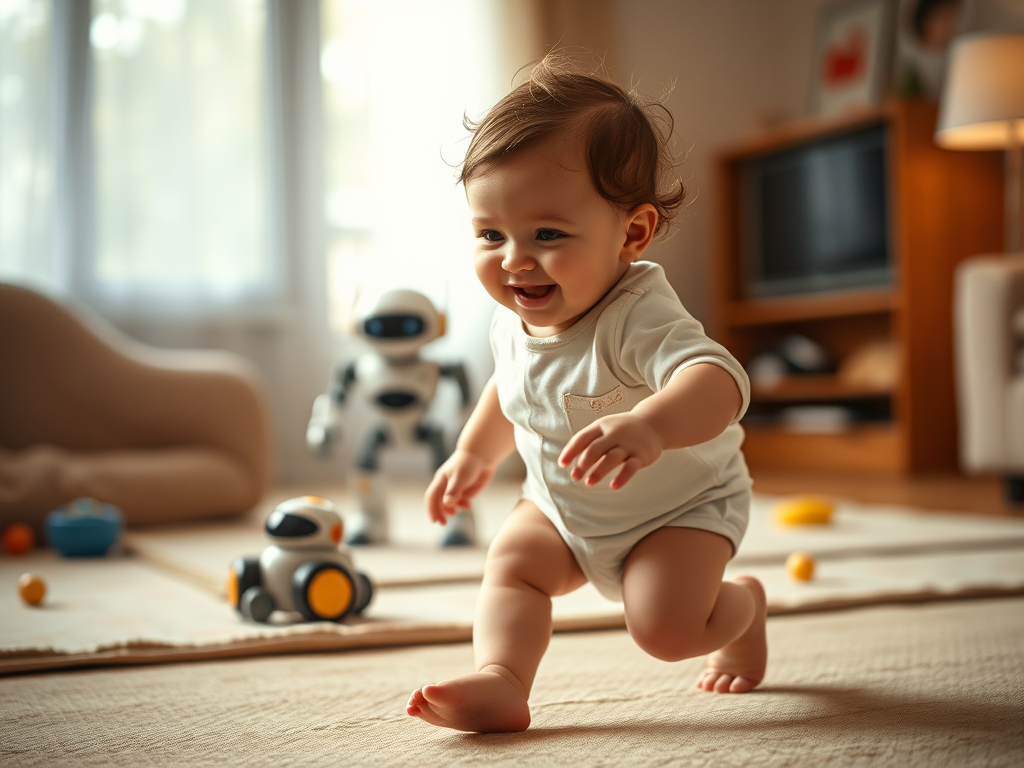
Becoming a father has been one of the most transformative experiences of my life. My daughter recently turned one, and every day brings a new milestone in her development. As a technology enthusiast and someone who works closely with AI and machine learning, I can’t help but notice how strikingly similar her learning process is to how machine learning models operate. The more data she encounters—the more experiences she has—the better she becomes at performing tasks, whether it’s walking, talking, or interacting with her environment. This parallel has been fascinating, and I wanted to share my observations.
Kids and AI: More Data, Better Performance
One of the core principles of machine learning is that the more data a model has, the better it becomes at making predictions and decisions. For example, in AI, a machine learns to recognize patterns, make connections, and eventually perform tasks—like recognizing images, driving cars, or even walking like a robot—through exposure to vast amounts of data. Similarly, my daughter’s learning journey has involved repeatedly interacting with her environment, observing patterns, making mistakes, and improving with each experience.
For instance:
• Learning to Walk: Robots learning to walk, like AI models, go through a process of trial and error, balancing themselves and improving over time with more practice. My daughter’s journey to taking her first steps felt very similar—she started by stumbling, crawling, and then gradually figuring out how to keep her balance and take her first real steps.
• Mimicking and Understanding: Initially, when she started saying words like “hi” or “no,” it felt like she was mimicking without fully understanding their meaning—much like how AI can “hallucinate” or make confident mistakes when it doesn’t fully comprehend context but tries to fit patterns together. Over time, with more data (experiences) and feedback, she began to understand when to say “hi” or “no” appropriately.
• Feedback and Corrections: In machine learning, feedback is critical. Just like an AI model improves when it receives corrections (i.e., supervised learning), my daughter learned how to better communicate or navigate her world when she received gentle guidance and corrections from us. Each experience refines her understanding, helping her make more accurate decisions the next time she’s faced with a similar situation.
AI “Hallucinations” and Early Childhood Mimicry
One concept in AI that I’ve found parallels in my daughter’s behavior is the phenomenon of AI hallucinations. This happens when AI systems produce results or make decisions that are confidently wrong—based on incomplete or misunderstood data. Early in her learning journey, my daughter would sometimes say things that were slightly off. For instance, she might say “hi” to objects or use “no” in contexts where it didn’t quite fit, but she was still mimicking based on the patterns she observed.
With time, and more interactions with the world, her usage of words became more accurate. Just like how AI models learn to distinguish correct outcomes from errors with enough training data and feedback, my daughter learned how to say the right thing in the right context as she grew more experienced.
The Importance of Diverse Data
Another important observation is the impact of the diversity of experiences. In machine learning, diverse and high-quality data helps the model generalize better. Similarly, I noticed that when my daughter was exposed to a variety of environments, people, and challenges, her learning improved exponentially. New experiences helped her adapt better and apply her learning in different situations—whether it was walking on different surfaces or interacting with different people.
Just as in AI, where a well-trained model can adapt to novel situations because it has been trained on a variety of data points, my daughter started showing a better ability to handle new tasks with confidence because she had been exposed to a broad range of experiences.
How My Daughter is Teaching Me About AI
As I observe her day-to-day development, I find myself reflecting on how similar her learning journey is to the work I do in AI. Here’s what I’m learning from her:
1. The Importance of Patience and Data: Whether it’s parenting or training an AI model, progress takes time, and there’s no substitute for patience. The more data (or experiences) we provide, the better the outcomes will be.
2. Feedback is Essential: Providing constructive feedback is critical to helping someone (or something) improve. AI models rely on labeled data and corrections to improve their predictions, just as my daughter needs guidance to learn how to walk or speak correctly.
3. Curiosity Drives Learning: AI models and humans both thrive on curiosity. My daughter’s desire to explore new things and ask questions about her surroundings mirrors how AI models learn by continuously improving based on new data inputs.
Conclusion
As a new father and an AI enthusiast, I’ve realized that both parenting and machine learning involve nurturing growth through experiences, feedback, and data. Watching my daughter grow and learn reminds me that the principles driving AI aren’t just relevant to machines—they’re an intrinsic part of human learning too.
Whether you’re raising a child or training an AI model, the journey is filled with small improvements, corrections, and eventually breakthroughs. Just as my daughter continues to amaze me with her progress, AI continues to evolve in incredible ways—both proving that more data, experience, and feedback lead to better performance.
Sources:
1. IBM Cloud. (n.d.). How machine learning works: Basics of training and feedback loops. IBM. Retrieved September 26, 2024, from https://www.ibm.com/cloud/learn/machine-learning
2. Built In. (n.d.). Understanding AI hallucinations and their impact. Built In. Retrieved September 26, 2024, from https://builtin.com/artificial-intelligence/ai-hallucination
3. Eunice Kennedy Shriver National Institute of Child Health and Human Development. (n.d.). The role of data in child development. NICHD. Retrieved September 26, 2024, from https://www.nichd.nih.gov/health/topics/early-learning
4. ScienceDirect. (2020). Teaching a humanoid robot to walk faster through Safe Reinforcement Learning. ScienceDirect. Retrieved September 26, 2024, from https://www.sciencedirect.com/science/article/pii/S1364661316300820


Leave a Reply